
An AI Trust Stack for Precision Oncology
EXPLAINABLE • TRACEABLE • GOVERNED 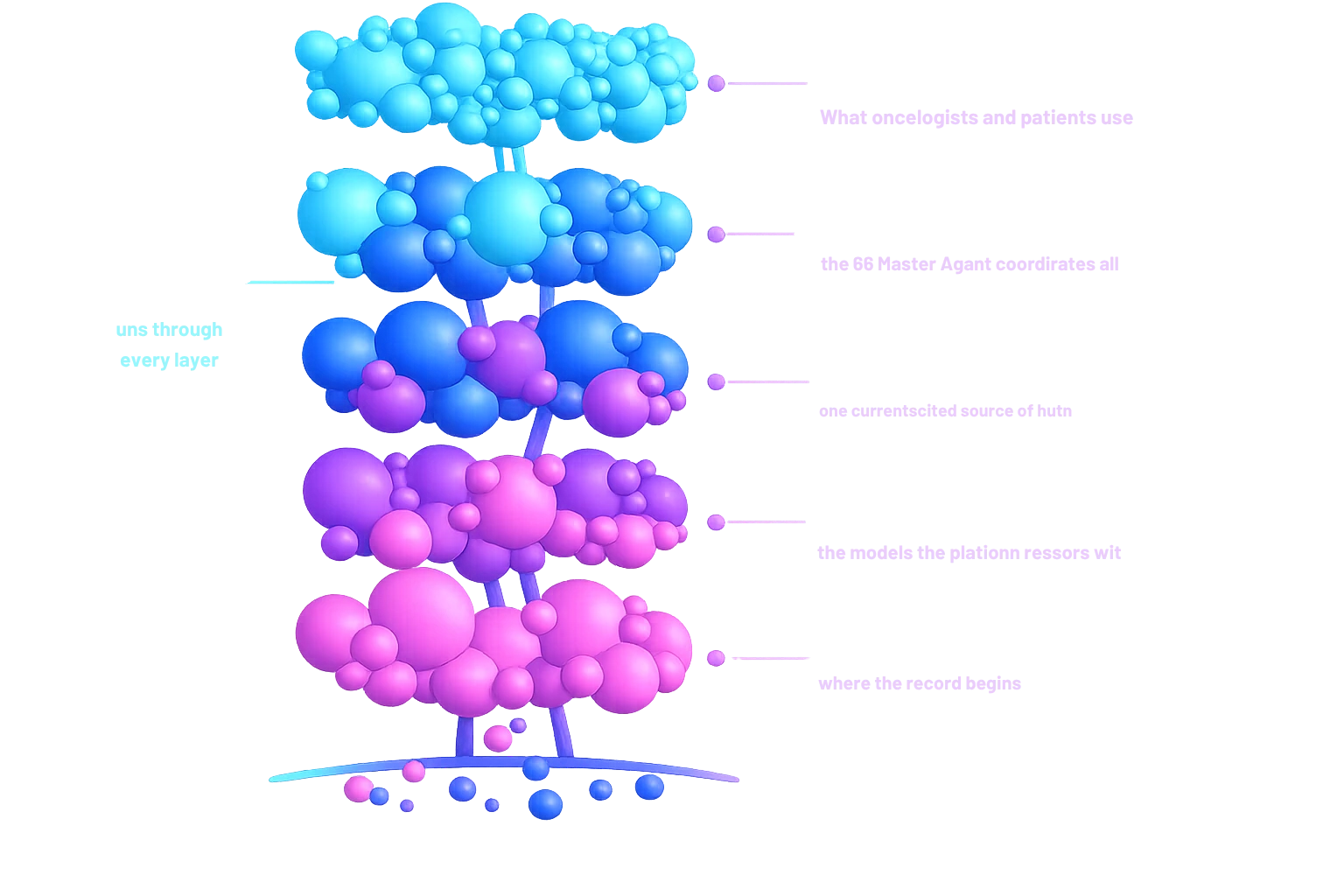
The gSage AI Stack
Five layers, from the EHR and lab data foundation to the clinical agents Oncologists and patients use, with evaluation, governance and security agents inspecting every one.
Cancer Deep Research Agent
Thinking + knowledge, cited
Digital Twin Therapy Simulation
Decision + evidence
Patient Response Monitoring
Care calibration
Pre-Auth + Payment Broker
Coverage & access
GeneSilico Master Agent
plans & reconciles
MCP + Tools
governed access
RAG + Knowledge Graphs
context
Loop Engineering
closed-loop recalibration
Casebook
clinic system of record
MyCasebook
patient companion
Cancer AI
semantic + patient graph
ChatGPT · Claude · Gemini
reasoning models
UpToDate · OpenEvidence · MedLM
evidence
Abridge · Dragon Copilot · Nabla
ambient scribe
Epic · Cerner · Athena
EHR
Tempus · Roche · Natera
Genomics + Labs
Flatiron · Cancer Databanks
real-world evidence
AI Orchestration for Cancer Platform
The gSage agentic stack coordinates every agent, tool and data source so the whole system reasons as one, moving cancer AI from decision support to decision intelligence.
AI Agents
Deep Research, Digital Twin, Monitoring and Pre-Auth master agents, each orchestrating scoped sub-agents up the stack.
Data Sources and Tools
EHR, labs, genomics, imaging and devices, reached in place via governed MCP servers behind the firewall.
RAG + Knowledge Graphs
Retrieval over the cancer oncology and patient-graph models brings the right context to every decision.
Loop Engineering
Input, reasoning, treatment, outcome, recalibration. Each closed loop makes the next recommendation sharper.
Every Patient Makes the Next One Sharper
Data flows continuously from EHRs, labs and cancer repositories into the agentic layers, and because each pass derives new structured data, the record deepens and the engines improve with every patient.
Calls variants, derives signatures (HRD, MSI), computes pathway-level scores against curated knowledge bases.
The OncoLLM family reads across years of record; annotation agents label every element against a purpose-built cancer ontology, making the data AI-workflow-ready.
The unified, cited record feeds the Digital Twin, Deep Research, Monitoring and Pre-Auth agents, clinical, administrative and research workflows all reading from one source of truth.
Live ctDNA and IoT data plus realized outcomes flow back to recalibrate the twin and retrain the engines.
Validation That Never Stops
Evaluation agents score every output against ground truth and guidelines on live dashboards, while the GeneSilico AI Agent Simulator proves each response through a full rules-and-safety gauntlet before it reaches care.
Onco Rules
Conforms to NCCN / ASCO guidelines for this tumor and line.
Patient Compliance
Safe for this patient: comorbidities, consent.
Treatment Accuracy
Holds up against real outcomes, calibrated.
Security
Every access in-policy, free of injection or tampering.
Continuous evaluation
Live accuracy dashboards by tumor type, model and workflow, stratified across subgroups to surface disparities.
Continuous training
Realized outcomes and reviewer feedback return to the engines; reliability improves with every case the platform sees.
Judge and Jury
for Every Output
Independent agents cross-examine every output against cited evidence and each other, catching unsupported content before it reaches care.
Compliance
Checked against HIPAA, HL7/FHIR and regulatory obligations, built into the architecture, not asserted after.

Cancer Guideline Adherence
Corroborated against NCCN, ASCO and cited source evidence, so what surfaces is grounded and defensible

Clinical Policy
Each provider’s own policies and formularies are enforced, so outputs match how this institution practices
Bias Detection
Individual clinician biases are surfaced and checked, keeping recommendations equitable.
Every Agent Runs
Under Control
A live control plane that governs how every agent runs, tracking identity, enforcing data access by policy, and stopping the adversarial attacks that target agentic systems handling patient data.

Agent Identity
and Registration
- Registered, allow-listed agents only
- Runtime-enforced YAML policy contract
- Non-compliant agents quarantined
Security Scanning
and Data Access
- Every call checked against policy
- Scans reachable MCP data sources
- Gateway logs every prompt and access
Attack Defense
- Prompt-injection detection
- Memory-poisoning prevention
- Runtime quarantine on any risk
What your
administrators see
A real-time view of how physicians and AI agents work together, how outputs perform for each patient, and where clinical workflows bottleneck, so administrators can act on it.

Physician + AI collaboration
Accept, edit or override, tracked per patient
Throughput and accuracy
Output quality by tumor type, model and workflow
Bottleneck resolution
Find where workflows stall, and fix them
Start with a pilot.
Scale with confidence.
A typical 60–90 day pilot stands up Casebook, the Cancer Digital Twin and the full AI Trust Stack behind your firewall establishing reliability, security and accuracy before scale.